Another baking-related post, because I had the time on the weekend to do some more cooking while my wife was out of town.
In my last post, blueberries were on sale. This time, Johannisbeeren were on sale, so I wanted to take advantage of the fresh fruit. Johannisbeeren are unfamiliar to me, being an Eastern US native, but I find them incredibly delicious. They are tart like a cranberry, but have a great “berry flavor” when sweetened that I find hard to resist. There are lots of Johannisbeeren pastries and tarts available here in Hesse, Germany, but this was my first opportunity to work with the fresh fruit. And without further ado, here’s a video demonstrating how I made puff pastries with fresh Johannisbeeren, with CC-licensed music by Jill Zimmerman.
There are a number of videos online illustrating the effect of increasing JPEG (JPG) compression on both file size and image quality (see example 1, example 2, or example 3). I wanted to try recompression on my own data because the effect can be recreated quickly using a simple MATLAB script. It is a very simple demonstration of the effect of lossy image compression. For a simple demonstration of the effect of compression, I load an image into MATLAB and then progressively increase the JPEG compression (by decreasing the ‘Quality’ parameter in imwrite), saving each incremental image as a frame. I then load all of the frames and assemble them into a video file. Here’s an example of increasing image compression at 10 frames per second:
In addition, I tried recompressing the image to see the effect of repeated JPEG compression on the output. An initial image is loaded, it is compressed, then that image is loaded and compressed at a lower quality, then that image is loaded and compressed at an even lower quality, and so on and so forth. Here’s the output at 10 frames per second when we do this from the least amount of JPEG compression (‘Quality’,100) to the most amount of compression (‘Quality’,0):
Just to be artistic, we can then repeat the cycle 10x and observe the effect of repeated compression. Here is an example at 30 frames per second with 10 loops of the repeated recompression:
Click through for the MATLAB code and a couple more example videos. Read More
Ok, so this post is not shape or electronics related, but still a fun little side project. Since I started working at Justus-Liebig-Universität in Gießen, Germany as a postdoc, my wife and I have cooked as much homemade food as possible. Germany is full of fantastic, inexpensive, and fresh ingredients, so we want to take advantage of whatever is available seasonally.
This week, blueberries were on sale, 0,49€ for 200g, and puff pastry dough is really inexpensive as well, 0,69€ for a sheet. So, here’s my first attempt at a “foodie” video demonstrating how I made puff pastries with fresh blueberry compote, with CC-licensed music by Jill Zimmerman.
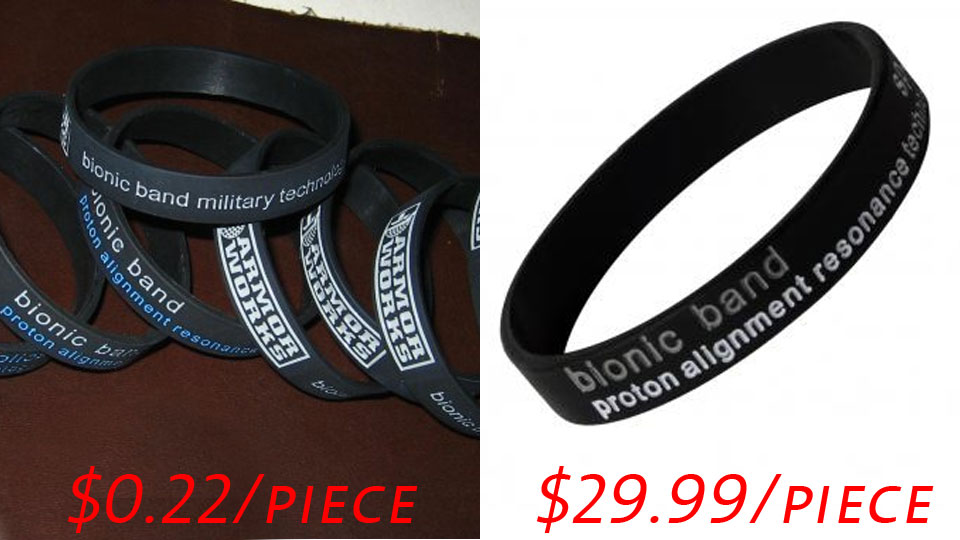
Turns out that one of the manufacturers of the “Bionic Band” has unintentionally outed it as being a $0.22 piece of silicone. If you haven’t seen the “Bionic Band” or the multitude of “power enhancing” silicon bands in stores, mall kiosks, and online, it is basically snake oil that salesmen are pushing as a miracle cure for all sorts of ailments.
Unfortunately for the sales rep, one of the wholesale manufacturers posted a picture online of a set of bands they produced. Check out SpeedyWristbands.com Wristband Pricing (look under “Deboss-Fill Wristbands”, here’s a direct link to the image and a mirror). Purchased in quantities, you can get them for $0.70/piece for a lot of 100, or as low as $0.22/piece for 20,000. These currently sell for $29.95 on the BionicBand website (see here or mirror here).
I’ve finally updated all the links on the site, so I want to state that all the content on this website is and will be covered under a Creative Commons Attribution-NonCommercial-ShareAlike 3.0 Unported License (unless otherwise stated):
I felt that my resume/curriculum vitae needed a quick way for people to get in touch with me, so I generated a QR code to encode my contact information. The QR code is scannable using a barcode reader app on most modern smartphones and will automatically pop up with my email and website contact information. I wanted the code to stand out, so, rather than embedding a logo/image into the center, I decided to go the psychophysical route and create a stereogram!
To view, focus eyes behind the image (diverge) or in front (converge, cross-eyed) so that the two images combine into one.
The stereogram was created by shifting a surface of pixels to the left in one image and right in the other (see an example in Wikipedia’s Random Dot Stereogram entry). When the two images are perceptually fused, you perceive the shift as a change in depth of the surface (more info in Wikipedia’s Autostereogram entry). The shift needed to be small enough that the codes would still be scannable (see Wikipedia again), but provide a convincing amount of depth.
I’ve switched hosting providers, so I am currently transitioning my blog from the old provider to the new one. There are a number of broken links and a number of issues that I am trying to resolve (specifically with my old folder organization structure for JAL code), but hopefully this will all be cleaned up soon!
Update 01/09/2012: Still slowly transitioning the old posts to WordPress. Unfortunately, there isn’t an easy way (that I am aware of) to convert my old static-page format into the dynamic WordPress format, meaning that I have to upload each image individually and fix the code in the posts. So, unfortunately, it’s taking longer than I would prefer. In addition, I have been transitioning from YouTube to locally hosted videos, but unfortunately, that has been a battle as well. So, things are in a bit of disarray at this point, but will get better soon (I promise!).