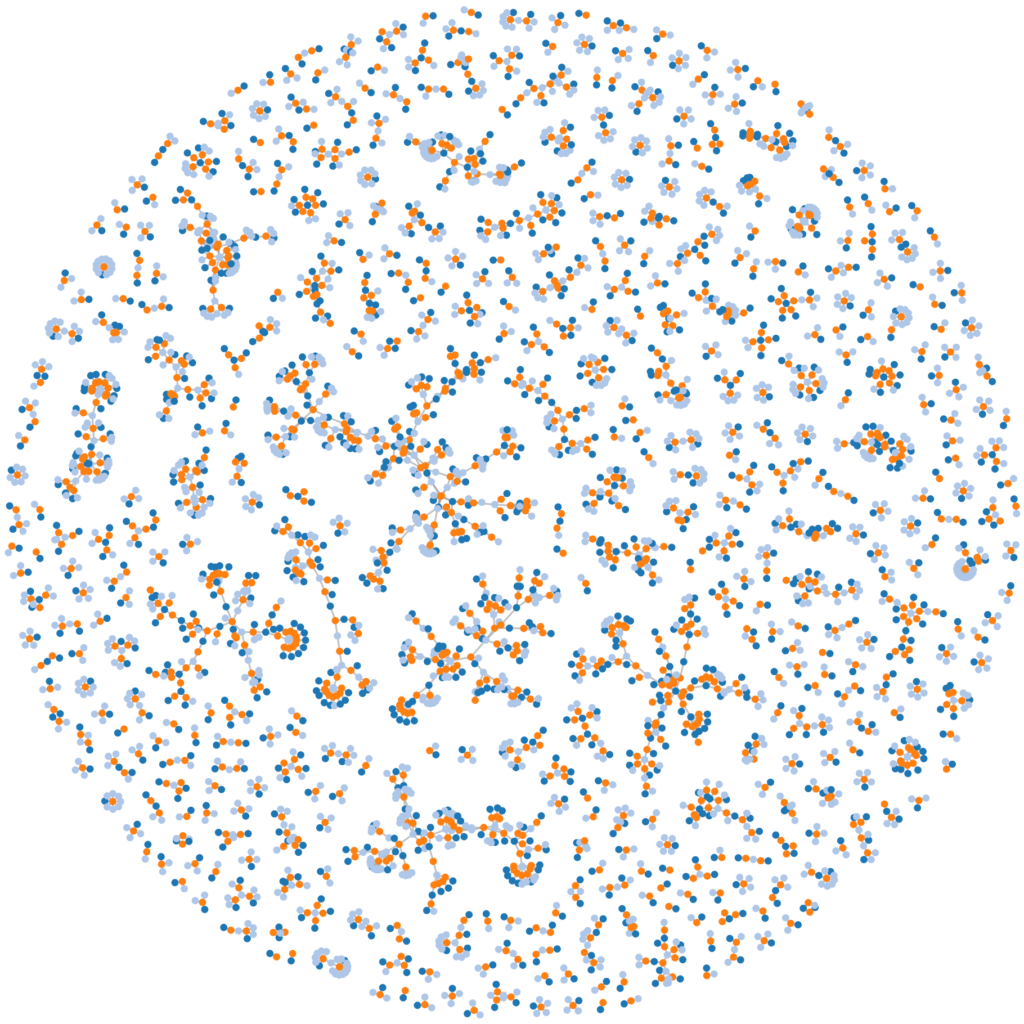
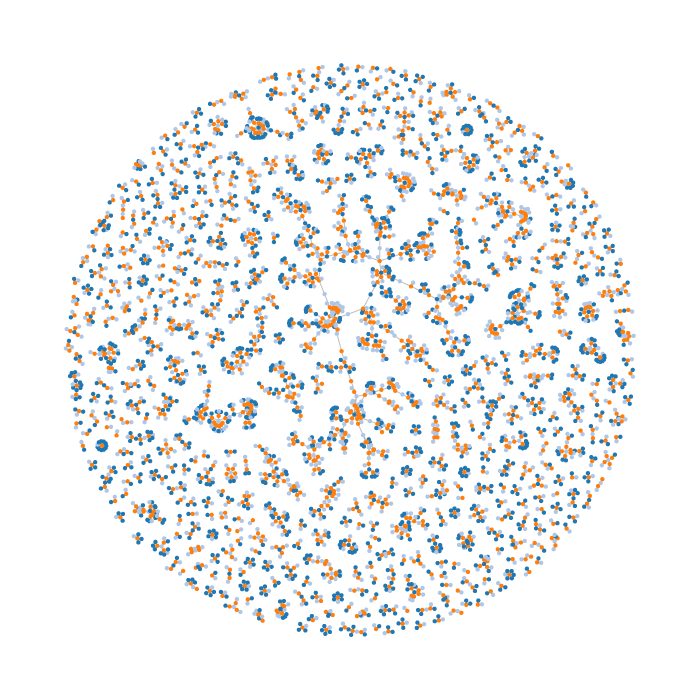
I felt that my resume/curriculum vitae needed a quick way for people to get in touch with me, so I generated a QR code to encode my contact information. The QR code is scannable using a barcode reader app on most modern smartphones and will automatically pop up with my email and website contact information. I wanted the code to stand out, so, rather than embedding a logo/image into the center, I decided to go the psychophysical route and create a stereogram!

To view, focus eyes behind the image (diverge) or in front (converge, cross-eyed) so that the two images combine into one.
The stereogram was created by shifting a surface of pixels to the left in one image and right in the other (see an example in Wikipedia’s Random Dot Stereogram entry). When the two images are perceptually fused, you perceive the shift as a change in depth of the surface (more info in Wikipedia’s Autostereogram entry). The shift needed to be small enough that the codes would still be scannable (see Wikipedia again), but provide a convincing amount of depth.
I’ve also attached an animated version (also scannable!) using the left and right images as frames (See Lee (1970) Binocular stereopsis without spatial disparity for additional discussion):
Read more…
I’ve switched hosting providers, so I am currently transitioning my blog from the old provider to the new one. There are a number of broken links and a number of issues that I am trying to resolve (specifically with my old folder organization structure for JAL code), but hopefully this will all be cleaned up soon!

Update 01/09/2012: Still slowly transitioning the old posts to WordPress. Unfortunately, there isn’t an easy way (that I am aware of) to convert my old static-page format into the dynamic WordPress format, meaning that I have to upload each image individually and fix the code in the posts. So, unfortunately, it’s taking longer than I would prefer. In addition, I have been transitioning from YouTube to locally hosted videos, but unfortunately, that has been a battle as well. So, things are in a bit of disarray at this point, but will get better soon (I promise!).
Update 02/29/2012: Ok, done! (I hope…)

Repel produces a number of DEET products intended to scare away those little flying buggers that seem to be everywhere on these warm summer nights. While walking through my local Target, I noticed that there were varying concentrations available for purchase at my local store (please excuse the hand-held photos):
| 23% DEET |
40% DEET |
100% DEET |
 |
 |
 |
After looking a bit closer at the labels though, I noticed something peculiar in the “Active Ingredient” list…
Read more…
What is everyone excited for??? More math! Ok, maybe not, but I’ll come back to the electronics projects later (including investigating the Parallax RFID reader, Arduino FIO, and heck, maybe even some more LED fun). In the meantime, let’s get back to math.

What do the volume calculations look like, and how would one go about calculating the center of mass/geometric centroid of a spherical plot? More after the break…
Read more…
My current research at Rutgers focuses on identifying the cognitive mechanisms that are employed when perceiving the shape and structure of 3D objects. One of the little problems that I had to overcome was finding out how to calculate the center of mass/gravity of a 3D surface of revolution analytically. Specifically, I needed to calculate the COM for conical frustums with and without an attached part (which was also analytically generated).

Unfortunately, it wasn’t as easy to derive as I assumed, but the steps toward that end are pretty straightforward. After the break you can see the general equation I ultimately derived for calculating the COM in 3D-space.
Read more…
So, this project was sidelined until I had to make another BatchPCB purchase. Thankfully it wasn’t too long until I had the opportunity to work on it again! The current setup is basically 4 of the original 4 RGB LED Controller boards and 12 of the updated DR1r3 boards. All 16 are wired in parallel and being controlled by my desktop machine. You can see an extended version of this RGB test sequence after the break and I’m also including the (uncommented, sorry!) Processing 1.1 code that I used to control the boards.
Read more…
I recently began working on a consulting project that required the creation of some PCBs. Since I have had such great success with BatchPCB.com in the past, I decided to use them again to fab the custom PCBs. The BatchPCB purchasing system adds a few static fees (set-up, handling, and shipping), so I felt that this was as good a time as any to make some additional of my PIC16F628 4 RGB LED PWM Controller boards with a couple of modifications.

Read more…
I have been neglecting semifluid.com for sometime now, but fear not! I will post new projects shortly as I try to dig through the comments. My time has been split between coursework (which is diminishing), research, and teaching. As I send revisions of papers back and forth with my advisor, I will devote time to updating the site. In the meantime, here are 3 videos demonstrating aftereffects that I created for my sensation and perception lab:
Read more…